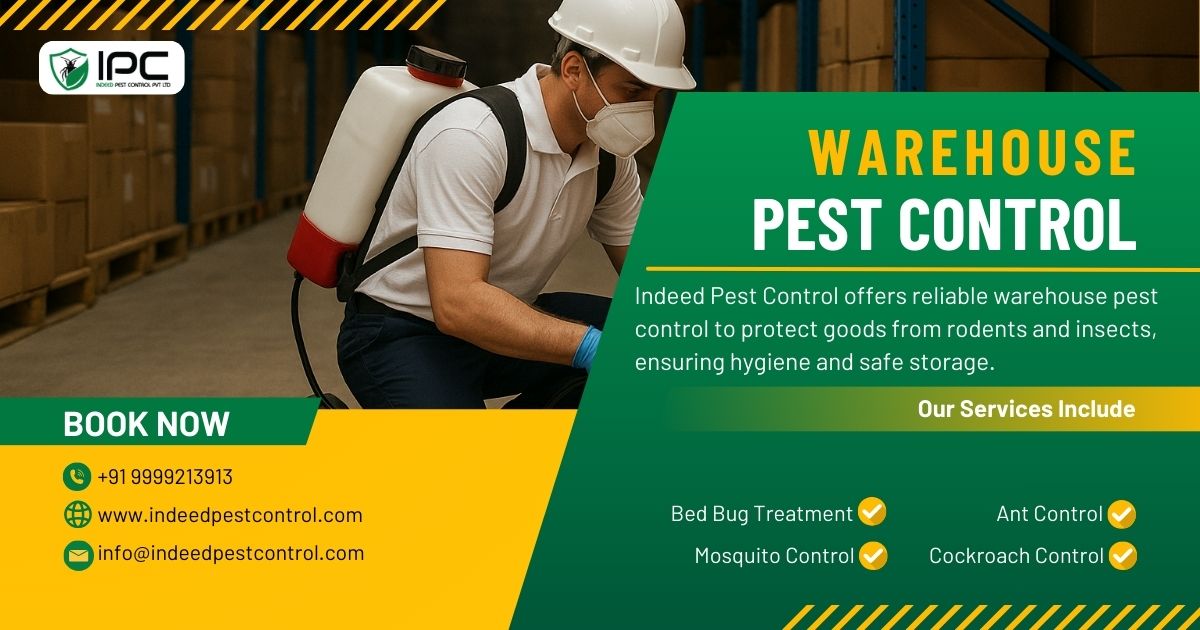
Warehouse pest control is the planned management of rodents, stored product insects, cockroaches, termites and birds in storage and distribution facilities. It covers everything from the perimeter and loading docks to racking, pallets, roof trusses and office areas. In a warehouse, one pest problem can reach thousands of cartons before anyone notices, and the cost shows up as rejected stock, failed audits and unhappy clients.
Indeed Pest Control provides warehouse pest control services for FMCG, food, pharma, e-commerce, cold storage and general goods warehouses. We plan treatments around your shifts and dispatch schedules, keep chemical use away from stored products, and maintain the records auditors ask for. To arrange a site survey, call +91 9999-213-913.
Why Warehouse Pest Control Matters
A warehouse holds your clients’ products and your reputation. When pests get in, the damage goes well beyond a few chewed boxes.
Contaminated and rejected stock. Rodent droppings, urine and gnaw marks make goods unsaleable, and stored product insects can spread through an entire lot of grain, flour, pulses, spices or dry fruits. A single contaminated consignment can be rejected by a client or retailer, along with everything stored near it.
Audit and compliance requirements. Food businesses regulated by FSSAI must keep pest control in place, and standards such as ISO 22000 and BRCGS expect a documented pest management programme with device maps, service records and corrective actions. Many retail and FMCG clients also audit their warehouse partners directly. Effective warehouse pest control, backed by clear records, keeps you ready for these checks.
Damage to infrastructure. Rats chew electrical cables, conveyor belts, pallet wrapping and insulation, which creates fire risk and costly downtime. Termites damage wooden pallets, doors and packing material, and birds block gutters and corrode roof structures with their droppings.
Client relationships. For 3PL operators, a pest complaint from one client can put a contract at risk. Consistent warehouse pest control shows clients that their goods are stored in a controlled, well-managed environment.
Common Pests in Warehouses
The pests you face depend on what you store, how the building is built and what surrounds it. These are the species we deal with most often in warehouse pest control.
Rodents
Rodents are the biggest threat to most warehouses. Rats and mice get in through open dock doors, drain lines, gaps under shutters and cracks around cable entries. Once inside, they nest behind stock, in pallet gaps and in false ceilings, and contaminate far more than they eat.
Stored Product Insects
Rice weevils, flour beetles, cigarette beetles, grain moths and warehouse moths feed on grain, flour, pulses, spices, dry fruits, tobacco and animal feed. They usually arrive inside inbound stock, then spread to clean lots nearby. Warm, humid conditions during the monsoon speed up their breeding. Checking inbound consignments at the dock, before they go into racking, is one of the simplest ways to stop an infestation from spreading through the warehouse.
Cockroaches
Cockroaches live in drains, washrooms, canteens and staff areas, and they move into storage zones at night. In food and pharma warehouses, even a few cockroaches can be flagged as a serious non-conformity in an audit.
Termites
Subterranean termites enter through the floor slab and wall joints and attack wooden pallets, doors, packing crates and paper-based packaging. Stock stored directly against walls or on old wooden pallets is especially exposed.
Birds
Pigeons and sparrows enter through open dock doors, ventilators and gaps in roof sheeting. They nest in roof trusses above racking, and their droppings contaminate stock, create slip hazards and corrode metal structures.
Flies, Ants and Lizards
Flies breed around garbage areas and drains and move into dispatch zones. Ants trail towards sugar, food and packaging, and lizards gather near lights and openings where insects collect.
Signs Your Warehouse Has a Pest Problem
Pests stay hidden in large, stacked spaces, so the early signs are easy to miss. Call for warehouse pest control if your team notices any of these:
- Droppings on pallets, shelves or along walls
- Gnawed cartons, shrink wrap, sacks or cables
- Grease marks along walls and around pipes
- Small holes, webbing or live insects in grain, flour or packaged goods
- Insects crawling on walls or collecting near lights
- Bird droppings on racking, stock or floors
- Mud tubes on walls or damaged wooden pallets
- A musty smell in closed storage areas
- Stock returned by clients because of pest damage
The earlier a problem is found, the fewer lots are affected and the less stock you have to write off.
Warehouse Types We Serve
Each type of storage brings its own risks, so our warehouse pest control services are planned around what you store:
- FMCG and food warehouses: stored product insects, rodents and cockroaches, with strict limits on chemicals near products. Our approach to pest control for the FMCG industry covers these supply chain needs in more detail.
- Grain, agri and godown storage: weevils, beetles, moths and rodents
- Pharma and healthcare warehouses: rodents, cockroaches and flying insects in controlled environments
- E-commerce and 3PL fulfilment centres: rodents and birds in high-traffic docks and mixed stock
- Cold storage: rodents around insulation and cockroaches in ante-rooms and plant rooms
- Textile, paper and packaging warehouses: termites, silverfish and rodents
- Electronics and industrial goods: rodents that chew wiring and packaging
Manufacturing units with attached storage can also be covered under our industrial pest control programme.
Our Warehouse Pest Control Process
Every facility differs in size, layout and stock, so we plan after seeing the site. Our warehouse pest control process follows integrated pest management (IPM), which focuses on inspection, exclusion, monitoring and targeted treatment rather than routine spraying.
- Site survey: Our team inspects the perimeter, docks, storage areas, racking, drains, roof and staff areas with your warehouse manager.
- Risk and zone mapping: Areas are classified by risk, from product storage to garbage and external zones, with the methods allowed in each.
- Pest control plan and device map: You receive a written plan with target pests, methods, visit frequency and a numbered map of every bait station, trap and insect light trap.
- Treatment: Work is carried out at agreed times, around shifts, loading windows and dispatch schedules.
- Monitoring: Devices are checked and recorded on every visit, so activity can be tracked zone by zone.
- Reports and trend analysis: Each visit is documented, and activity is compared over time to spot problem areas early.
- Corrective actions: When we find entry points, damaged doors or hygiene gaps, we record them and share clear recommendations with your team.
- Review: The plan is reviewed with you regularly and adjusted as stock, seasons or activity change.
On the first visit, the technician spends most of the time inspecting. They will walk the perimeter, check dock seals and shutters, look behind racking and inspect the roof line for bird entry. It helps to have your warehouse or facility manager available, since your team knows where problems have been seen.
Want to know how exposed your facility is? Book a site survey and our team will assess your warehouse and share a proposal.
Warehouse Pest Control Services and Treatment Methods
The right method depends on the pest, the zone and what is stored nearby. In product storage areas, we use non-chemical and low-exposure methods wherever possible.
Rodent Control Programme
Rodent control in warehouse pest control works in layers. Locked, tamper-resistant bait stations are placed at regular intervals along the external perimeter to stop rats before they reach the building. Inside, we use mechanical traps and glue boards rather than toxic bait, so no poison sits near stock and no rodent dies behind racking. Door seals, drain covers and gaps around pipes are checked and proofing recommendations are made.
Fumigation for Stored Product Pests
When stored product insects infest grain, pulses, spices or other commodities, fumigation is often the most effective way to treat an entire stack or container, since the gas reaches insects hidden deep inside bags and cartons. Phosphine fumigation is a regulated process, carried out by trained operators under a sealed cover with the area cordoned off and aerated before anyone re-enters.
Insect Control and Fly Management
Insect light traps are placed near dock doors, dispatch areas and staff entrances to catch flying insects without spraying. Crawling insects in drains, washrooms and canteens are treated with gel bait and targeted crack-and-crevice treatments. Storage zones are monitored with pheromone and sticky traps to detect stored product insects early.
Anti-Termite Treatment
When termites are active, anti-termite treatment is carried out by drilling along affected walls and floor joints and injecting termiticide to form a barrier in the soil. Infested pallets and wooden fixtures should be removed or treated, and stock should be kept away from walls to make inspection easier.
Bird Proofing
Bird control focuses on keeping birds out rather than removing them repeatedly. Netting under roof trusses, spikes on ledges, strip curtains or fast-closing doors at docks and mesh on ventilators stop birds from nesting above stock.
Pest Control Documentation for Audits
Auditors judge a pest control programme largely by its records. A complete warehouse pest control file should include:
- A pest control plan and scope of work
- A numbered device map showing every bait station, trap and insect light trap
- Visit reports with dates, areas covered, findings and treatments
- Device inspection records and activity trends over time
- A list of products used, with safety data sheets
- Corrective action records, showing what was found and what was fixed
- Technician details for each visit
We keep this documentation up to date on every visit, so the file is ready when a client, FSSAI officer or third-party auditor arrives. If an audit raises a pest-related observation, we help you close it with a documented corrective action and follow-up check.
How Often Should a Warehouse Get Pest Control?
Most warehouses need warehouse pest control visits at least monthly, with device checks on every visit. Food, grain and pharma warehouses often need fortnightly or even weekly monitoring, especially in high-risk zones. Activity rises during the monsoon, so many facilities add extra visits from June to September.
Fumigation and anti-termite treatment are done as needed rather than on a fixed cycle, usually when monitoring shows insect activity in stock or termite signs in the structure.
Warehouse Pest Control AMC: What It Covers
Most facilities choose an annual maintenance contract because it fixes the schedule, scope and responsibility for the year. A typical warehouse pest control AMC includes:
- Scheduled visits, usually monthly or fortnightly
- Perimeter rodent bait stations and internal traps, serviced on each visit
- Insect light trap and monitoring trap checks
- Crawling insect treatment in drains, washrooms and canteens
- Visit reports, device maps and trend records
- A point of contact for complaints and urgent call-outs between visits
Fumigation, anti-termite treatment and bird proofing are usually quoted separately, since they depend on the size and severity of the problem. Before signing, check which pests and areas are covered, the number of visits, how complaints are handled and what documentation you will receive.
What Affects Warehouse Pest Control Cost
Warehouse pest control cost depends on the facility and the risk, so we quote after a site survey. The main factors are:
- Size of the facility: total floor area, height and number of docks
- Type of stock: food, grain and pharma storage need closer monitoring
- Pests covered: rodent, insect, termite and bird control need different methods
- Level of infestation: an early problem costs less than an established one
- Visit frequency: monthly, fortnightly or weekly monitoring
- Audit requirements: the level of documentation your clients or certifications demand
- Additional services: fumigation, anti-termite treatment or bird proofing
Over a full year, a planned programme almost always costs less than the stock you would write off after an infestation. Call +91 9999-213-913 for a site survey and a quote based on your warehouse.
Pest Prevention Checklist for Warehouses
Professional warehouse pest control works best when your team keeps up basic housekeeping between visits.
Daily:
- Keep dock doors and shutters closed when not loading
- Sweep up spilled product, especially grain, flour and sugar
- Empty bins and keep garbage areas away from dock doors
- Report any droppings, gnaw marks or insects to the supervisor
Weekly:
- Inspect inbound stock for insects, webbing or damaged packaging before putting it away
- Clean under racking and around pallets
- Check that stock is not stored directly against walls, leaving an inspection gap
- Clean drains and floor traps
Monthly:
- Rotate stock on a first-in, first-out basis
- Check dock seals, door brushes and shutter gaps
- Inspect roof sheeting, ventilators and gutters for bird entry
- Remove damaged wooden pallets and old packaging
- Review pest control reports and close any open corrective actions
Why Choose Indeed Pest Control
Indeed Pest Control has been providing pest management for more than 25 years, for homes, offices and commercial properties. In warehouse pest control, that experience shows in how we plan around stock, shifts and audit schedules.
- IPM-based plans focused on exclusion and monitoring, not routine spraying
- Herbal and chemical options, chosen zone by zone
- Treatments scheduled around loading and dispatch windows
- Device maps, visit reports and trend records for audits
- Warehouse pest control services across Delhi, Noida, Gurgaon, Ghaziabad and Faridabad
To discuss a warehouse pest control AMC for your facility, call +91 9999-213-913.
Book a Warehouse Pest Control Survey
Pests in a warehouse are easiest and cheapest to control before they reach your stock. Call Indeed Pest Control on +91 9999-213-913 to book a warehouse pest control survey and get a programme built around your facility, stock and audit needs.
Insects services
Services
- Hotel Pest Control Services
- Restaurant Pest Control Services That Keep Your Kitchen Inspection-Ready
- Society Pest Control
- School & College Pest Control
- Pre Construction Termite Control
- Commercial Pest Control
- Industrial Pest Control
- Hospital Pest Control Services That Protect Patients and Staff
- Pipeline Termite Treatment
- Residential Pest Control Services
- Post Construction Anti Termite Treatment Services