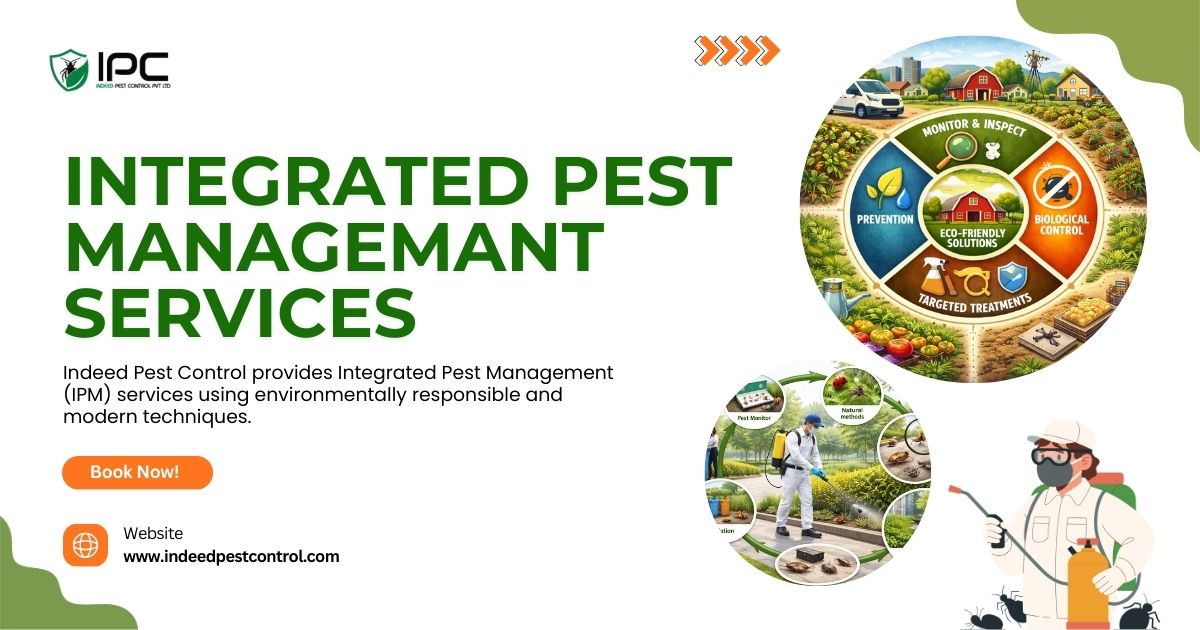
Integrated pest management is a science-based, environmentally friendly approach that solves pest problems in urban, agricultural, and wildland or natural areas. Rather than relying solely on chemical applications, integrated pest management emphasizes understanding pest biology, ecosystem interactions, and economic thresholds before taking action. This method teaches us that pests are also part of our natural systems and that treating them indiscriminately with toxic chemicals should be avoided. The concept of IPM is built on prevention and informed decision-making. Indeed Pest Control, a trusted name in the pest control industry, adopts this balanced framework to deliver effective solutions while prioritizing the ecosystem. By following modern IPM strategies, the company ensures sustainable pest control that protects human health, property, and nature.
What Is IPM (Integrated Pest Management)?
Integrated Pest Management (IPM) is an efficient and ecologically conscious method of controlling pests by using a variety of sensible techniques. It is considered one of the most cost-effective methods for managing pest problems. Instead of relying on a single control method, IPM combines prevention, monitoring, and targeted control measures with modern pest control techniques. This approach reduces pest damage while minimizing risks to human health, property, and the environment, making it a safe and sustainable solution for long-term pest management.
Integrated Pest Management Meaning
The integrated pest management definition states that it is a sustainable and environmentally responsible approach to pest control that combines biological, cultural, physical, and chemical methods to prevent and manage pest populations.In simpler terms, understanding what is IPM means knowing it is a method of managing pests using a mix of safe techniques, such as hygiene, monitoring, and natural controls, with minimal use of chemicals. It focuses on regular monitoring, accurate pest identification, and the use of preventive measures, with chemical pesticides applied only when necessary and in a targeted manner. The main goals and tools of IPM are to prevent pest problems in the long term, reduce damage, protect human health and the environment.
Concept of Integrated Pest Management
The foundation of integrated pest management (IPM) is the belief that pest control methods should be more effective. The core concept of IPM is to manage pests in a way that reduces risks to humans, animals, and the environment while maintaining economic viability. Instead of depending exclusively on chemical pesticides, IPM promotes natural techniques, traps, and preventative measures to make this system function successfully.
Principles of Integrated Pest Management
IPM is a collection of pest management assessments, choices, and actions rather than a single pest control technique. The principles of integrated pest management guide farmers who are aware of the possibility of insect infestation to follow the below-mentioned five-tiered approach:
- Prevention
- Monitoring
- Economic Threshold
- Decision-Making
- Evaluation
Core Principles Explained
Prevention
Prevention is the first and one of the most powerful principles of IPM. It focuses on stopping pests before they become a major threat. Its preventative pest control techniques include cleaning surroundings, proper sanitation, sealing entry points, and planting healthy soil to make a challenging environment for pests. Reducing food, shelter, and breeding spaces helps to minimize the chances of their appearance.
Monitoring
Monitoring is like spying pest activity every day. Regular inspections, changing traps, and visual checks help track them and create well-suited IPM strategies. Keeping good records of pest populations and noting down each of their actions is important for deciding when it is time to act. Without proper monitoring, pest control becomes guesswork.
Economic Threshold
Not all insects, weeds, and other living organisms need to be controlled. Many organisms are harmless, and some are even beneficial. Indeed Pest Control’s professionals allow pests to exist at low levels and will take action only if their numbers reach a point where damage would cost more than the control itself. These principles of integrated pest management prevent unnecessary treatments and save sufficient money.
Decision-Making
Based on monitoring data and economic thresholds, it’s an exact correct time to make decisions between these two principles of IPM. The pest management team only chooses the safest and most effective control method where the use of chemicals can be avoided or used in a truly required amount.
Evaluation
Evaluation is the last step of principles of integrated pest management. After control measures are applied, a complete result report is reviewed to understand the success rate of each treatment and which IPM strategies should be improved for the future. This is a learning process to make this approach smarter, more efficient, and more sustainable over time.
Components of IPM
Integrated pest management is the smartest approach, following mix-and-match strategies to control pests effectively without disturbing Mother Earth. The following components of IPM are often used in pest control techniques:
Biological Control
Biological control or bioprotection is the use of natural enemies to control pest populations naturally without harming humans or beneficial species. For example,
- ladybugs to control aphids
- certain fungi or bacteria to suppress insect larvae
- applying natural microbes to stop pest growth
Cultural Control
Cultural control involves modifying farming or management practices to make the environment less favorable for pests. This includes:
- crop rotation can stop the pest’s life cycle by swapping the host plant with a non-host plant
- adjusting planting and harvesting times to avoid peak pest activity periods.
- removing ill and dead plants (i.e., rogueing) to prevent the growth of pest population
- proper plant spacing to improve air circulation and reduce pest-friendly conditions.
Mechanical & Physical Control
The goal of mechanical or physical pest control methods is to manually eradicate the pest or interfere with their activity. This is a quick and effective practice that includes:
- removing pests with hands
- mesh screens or nets to create a barrier and traps
- high pressure water spraying to remove pests from the leaves and stems of the plants
Chemical Control
This should be the last priority integrated pest management methods after all previous components of IPM fail. The use of chemicals should be limited without impacting the environment.
- choose chemicals with minimal host range
- only address the pest-affected areas
- rotate pesticide classes to prevent the pests from developing resistance
Tools and Methods Used in IPM
Protect, prevent, and preserve defines the best way of integrated pest management meaning.
The tools of IPM are especially designed in such a way that it help in the best possible way to implement sustainable pest control.
Monitoring Tools: Sticky traps, pheromone traps, light traps, and inspection kits are frequently utilized to identify pest populations at early stages.
Biological Methods: To use natural predators, parasites, or beneficial microbes as biological control agents. These methods align with the components of IPM by reducing chemical dependency.
Cultural and Mechanical Tools: Crop rotation, correct spacing, trimming, and mulching are preventive strategies that diminish pest-friendly conditions. Pests can be physically controlled without the use of chemicals by using mechanical instruments such as water sprays, barriers, nets, and hand plucking.
Chemical Tools: As part of integrated pest management methods, chemicals are selectively used to maintain sustainable pest control and ensure they do not harm human health, property, and the environment.
Integrated Weed Management (IWM) as Part of IPM
IPM and IWM are two sides of the same coin: one manages pests, the other manages weeds, but both focus on long-term, sustainable crop health. After understanding the components of IPM, it is essential to appreciate integrated weed management as an integral part of sustainable crop protection.
What Is Integrated Weed Management?
Using a variety of techniques to control weeds in an affordable and ecologically responsible way is known as Integrated Weed Management. It works closely with Integrated Pest Management (IPM). While IPM focuses on controlling insects, rodents, and other pests, IWM targets weeds that support pest growth. When weeds are properly managed, pests are left with fewer places to hide and breed. This makes IPM more effective and reduces the need for chemical pesticides.
In an IPM framework, weed control decisions are based on monitoring and threshold levels, not routine spraying. They are managed only when they reach a peak level at which they might cause economic or environmental harm. This strategy promotes healthier soil and biodiversity while reducing needless chemical use.
When combined with IPM, it reduces production costs, minimizes environmental hazards, and builds strong cropping systems. Together, IWM and IPM offer a balanced, smart, and holistic approach to long-term weed and pest management.
IPM vs IWM
| IPM | IWM | |
| Full Form | Integrated Pest Management | Integrated Weed Management |
| Purpose | Manages insects, rodents, and diseases. | Controls weeds that compete with crops. |
| Methods | Uses natural predators, cultural practices, traps, and minimal chemicals. | Uses crop rotation, proper planting times, mulching, hand weeding, and selective herbicides. |
| Monitoring | Regular inspection, traps, pest counting | Weed mapping, growth observation, field scouting |
| Connection | Reduces pests hiding in weeds | Supports IPM by eliminating pest shelters provided by weeds |
| Scope | Broader | Narrower |
Examples of Integrated Pest Management
Real-world integrated pest management examples can be observed across agriculture, home settings, and commercial environments, where pest control decisions are solely based on biology, monitoring, and prevention rather than routine chemical use.
Agriculture
In farming scenarios, IPM includes planting resistant crop varieties, rotating crops to disrupt pest life cycles, and protecting natural predators such as beneficial insects or birds. The pest control management team keeps a close eye on bug populations and takes immediate action only when the harm becomes financially significant. This strategy shows how integrated pest management works while preserving the health of the soil and environment.
Home/Urban
In residential areas, IPM strategies work differently. To prevent pests like cockroaches, ants, termites, and rodents, it follows general instructions such as sealing access holes, reducing moisture, and maintaining sanitation. Traps and physical barriers are given more importance over chemical sprays. These integrated pest management examples demonstrate that environmental control can be more effective than relying on chemicals alone.
Commercial Environment
IPM places a strong emphasis on waste management, staff awareness, and inspection in commercial areas such as MNC offices, food facilities, and warehouses. Integrated pest management methods are reliable for delivering long pest suppression with reduced chemical dependency. Monitoring tools such as sticky traps and pheromone traps are used to detect pests early which helps prevent infestations while adhering to safety and legal requirements.
Integrated Pest Management vs Conventional Pest Control
Core Process
IPM (what is IPM): It focuses on long-term solutions through ecological balance and informed decision-making.
Conventional Pest Control: It focuses on eliminating pests quickly using strong chemicals.
Decision-Making Process
IPM: It follows a systematic approach and undergoes the procedure of pest identification, continuous monitoring, and economic threshold levels before taking action.
Conventional Pest Control: It follows fixed schedules of routine spraying.
Use of Chemicals
IPM: In IPM, using pesticides will be the last priority and are carefully selective in measurable quantities.
Conventional Pest Control: It heavily depends on broad-spectrum pesticides.
Impact on Resistance
IPM: This process slows pest resistance by rotating control methods and preserving natural enemies.
Conventional Pest Control: This method accelerates resistance due to repeated use of the same chemicals.
Environmental Effects
IPM: This is a very sustainable approach because it protects beneficial insects, soil organisms, and overall biodiversity.
Conventional Pest Control: This technique is usually toxic in nature as it may harm non-target species and disrupt ecosystems.
Economic Perspective
IPM: It reduces long-term expenditures but requires a good budget for greater initial planning and monitoring costs.
Conventional Pest Control: It may seem economical at first but resistance and heavy chemical usage in every visit eventually result in higher expenditures.
How To Begin Your IPM Journey
Your IPM journey starts with knowledge. Learn what is IPM and apply the principles of integrated pest management to prevent problems, monitor activity, and use safe control methods. And for the professional support contact Indeed Pest Control at They help you protect your home, workplace, or farm while reducing chemical use and long-term costs.
Don’t grant pests more time to settle, go green with Indeed Pest Control and embrace your IPM adventure today!